Annual Cyber Threat Report 2025-26
The 2025-26 Annual Cyber Threat Report highlights key threats, responses and security advice for Australians.

Year in Review
What ASD’s ACSC saw

| Answered over 37,500 calls to the Australian Cyber Security Hotline, down 12%.
|

| Received over 82,000 cybercrime reports to ReportCyber.
|

| Individuals Average self-reported cost of cybercrime per report for individuals remained consistent with last year ($33,000). |

| Business
|

| Identity fraud remained the top reported cybercrime, down 18% from last year. |

| Publicly reported common vulnerabilities and exposures (CVEs) increased 30%. |

| Over 2,959,800 total users visited cyber.gov.au, generating nearly 6,281,700 views. |

| Over 262,800 downloads of our advice or guidance on cyber.gov.au. |
What ASD's ACSC did

| Responded to over 1,500 cyber security incidents, up 20% from last year. |

| Notified entities of potential malicious cyber activity more than 4,400 times, up almost 80%, to help prevent incidents before they occurred, including:
|

| Identified 362 incidents following proactive notifications. |

| Responded to 139 ransomware incidents, consistent with last year. |

| Australian Protective Domain Name System processed more than 220 billion queries and blocked customer access to over 564 million malicious domains. |

| Cyber Threat Intelligence Sharing (CTIS) grew by 22% to over 550 partners, and shared over 1 million indicators of compromise via the platform. |

| ASD’s Cyber Security Partnership Program grew by 12% to over 149,500 partners. |

| Led 15 cyber security exercises, involving over 335 organisations. |

| Briefed board and executive leadership team representatives from 29% of the ASX100. |

| Published 52 publications to the Partner Portal. |

| Published a total of 76 alerts, advisories and publications on cyber.gov.au, including a range of joint products with international partners. |

| Cyber Hygiene Improvement Programs
|

| Government Uplift Program
|

| Critical Infrastructure (CI) Uplift Program
|
Timeline of key events and publications
| July 2025 | |
| 9 July | Protect Your Devices SMB Checklists guidance published |
| 30 July | Scattered Spider advisory published |
| August 2025 | |
| 14 August | Foundations for OT Cyber Security guidance published |
| 26 August | Managing Cryptographic Keys and Secrets guidance published |
| 28 August | Countering Chinese State-Sponsored Actors Compromise of Networks Worldwide to Feed Global Espionage System advisory published |
| September 2025 | |
| 4 September | A Shared Vision of Software Bill of Materials for Cybersecurity guidance published |
| 12 September | Information Security Manual updated |
| 22 September | Planning for Post-quantum Cryptography published |
| October 2025 | |
| 13 October | CI Fortify published |
| 15 October | Mitigations for Network Defence published |
| 16 October | Machine Learning Supply Chain Risks and Mitigations published |
| 20 October | Cloud Shared Responsibility Model published |
| 23 October | Investing in Modern Defensible Architecture published |
| 28 October | Creating and Maintaining a Definitive view of an Operational Technology Architecture published |
| 30 October | Cyber Security Priorities for Boards of Directors 2025-26 guidance published |
| 31 October | Microsoft Exchange Security Best Practice published |
| November 2025 | |
| 20 November | Bulletproof Defence: Mitigating Risks from Bulletproof Hosting Providers published |
| December 2025 | |
| 4 December | Principles for the Secure Integration of Artificial Intelligence in Operational Technology published |
| 4 December | Information Security Manual updated |
| 10 December | Pro-Russia Hacktivists Conduct Opportunistic Attacks Against US and Global Critical Infrastructure advisory published |
| 15 December | Quantum Technology Primer for Cybersecurity Leaders published |
| January 2026 | |
| 14 January | Artificial Intelligence for Small Businesses published |
| 15 January | Secure Connectivity Principles for Operational Technology (OT) published |
| February 2026 | |
| 19 February | Quantum Technology Primer: Computing published |
| March 2026 | |
| 5 March | Artificial Intelligence and Machine Learning: Supply Chain Risks and Mitigations published |
| 6 March | INC Ransom Affiliate Model Enabling Targeting of Critical Networks published, marking the first time an ASD ACSC joint advisory was co-sealed with a Pacific Island Nation (the Kingdom of Tonga) |
| 17 March | Information Security Manual updated |
| 18 March | Quantum Technology Primer: Communications published |
| 25 March | Securing Space published |
| April 2026 | |
| 24 April | Defending against China-nexus Covert Networks of Compromised Devices published |
| May 2026 | |
| 1 May | Careful Adoption of Agentic AI Services published |
| 7 May | ClickFix Distributing Vidar Stealer via WordPress Targeting Australian Infrastructure Advisory published |
| 27 May | Opportunities for AI in Cyber Defence published |
| June 2026 | |
| 9 June | Guidelines for System Hardening Advice published |
| 9 June | Guidelines for Software Development Advice published |
| 9 June | Information Security Manual updated |
| 22 June | Five Eyes Cyber Security Agencies Statement published |
| 24 June | Quantum Technology Primer: Sensing published |
ASD’s ACSC categorises each cyber security incident it responds to on a scale of Category 1 (C1), the most severe, to Category 6 (C6), the least severe. Cyber security incidents are categorised on severity of impact and significance of the organisation’s impact to Australia.
| SIGNIFICANCE | |||||||
|---|---|---|---|---|---|---|---|
| Member(s) of the public | Small organisation(s), Sole traders | Medium-sized organisation(s), Schools, Local government | State government, Academia/R&D, Large organisation(s), Supply chain | Federal government, Government shared services, Regulated critical infrastructure | National security, Systems of National Significance | ||
| EFFECT | Denial of Essential Systems | 0 | 0 | 0 | 0 | 0 | 0 |
| Extensive Incident | 0 | 9 | 17 | 13 | 1 | 0 | |
| Localised Incident | 0 | 15 | 12 | 12 | 2 | 0 | |
| Isolated Incident | 2 | 110 | 58 | 47 | 22 | 2 | |
| Low-level malicious attack | 0 | 174 | 81 | 117 | 85 | 2 | |
| Unsuccessful Low-level Malicious Incident | 0 | 28 | 36 | 194 | 466 | 19 | |
FY2025–26 demonstrated that the cyber threat environment continues to be shaped by compromises from well known weaknesses such as unpatched systems and social engineering, while the operating environment continues to evolve. More interconnected systems, third party suppliers and supply chains mean one compromise makes incidents far more complex in this current environment. FY2025–26 also saw cyber security awareness growing and improved reporting practices across the economy.
In FY2025–26, ASD’s ACSC responded to over 1,500 incidents, an increase of more than 20% from last year. Of the incidents ASD’s ACSC responded to this year, 362 were identified following proactive ASD’s ACSC notifications to entities of potential malicious activity on their network. In FY2025–26, ASD’s ACSC issued over 4,400 notifications (including mass notifications) of suspicious cyber activity, almost 80% more than FY2024–25. More than 51% of individual notifications originated from declassified intelligence, providing reliable and actionable information directly to Australian organisations.
- A collective notification to 340 entities in May 2026 regarding the cPanel CVEs resulted in more than 60 confirmed incidents.
- ASD’s ACSC received fewer phone calls reporting cyber security incidents this financial year; however, the number of incidents reported (including unsuccessful incidents) increased, which likely indicates improved cyber security awareness and reporting culture.
Incidents categorised as C3 or above often involve organisations such as federal and state governments, large organisations, academia and supply chains. While the number of higher categorised incidents decreased in FY2025–26 with only one C2 incident recorded, the number of extensive compromises increased from 26 in FY2024–25 to 40 in FY2025–26. Furthermore, analysis of MITRE ATT&CK tactics, techniques and procedures (TTPs) indicates an increasing complexity in depth and breadth of cyber tactics. Of note:
- The frequency of ‘User Execution’ and ‘Social Engineering’ techniques demonstrates that humans remain an enduring target for all incident categorisations.
- The high rate of ‘Data Encryption for Impact’ suggests that ransomware is a strong contributor to C3 and higher incidents in FY2025–26.
In previous years, major Denial of Service (DoS)/Distributed Denial of Service (DDoS) campaigns accounted for higher incident numbers; however, due to the absence of any coordinated DDoS campaigns by malicious cyber actors in FY2025–26, ASD’s ACSC recorded lower numbers of DoS/DDoS incidents. ASD’s ACSC responded to more than 80 incidents involving DoS/DDoS,down more than 60% from last year.
DoS/DDoS attacks remain a common tactic used to disrupt services and affect organisational operations. Although fewer incidents were reported, those that did occur resulted in more significant impacts. Extensive compromises from DDoS activity increased from one in FY2024–25 to seven in FY2025–26.
ASD’s ACSC is consistently seeing cyber security incidents resulting from unpatched vulnerabilities. This year, ASD’s ACSC recorded successful exploitation of a vulnerability identified in 2008, demonstrating the need to patch legacy vulnerabilities, as well as keeping on top of patching new ones. AI is reducing the expertise and effort required to identify and exploit vulnerabilities, likely accelerating Time to Exploit (TTE) and increasing the number and diversity of actors able to undertake cyber attacks.
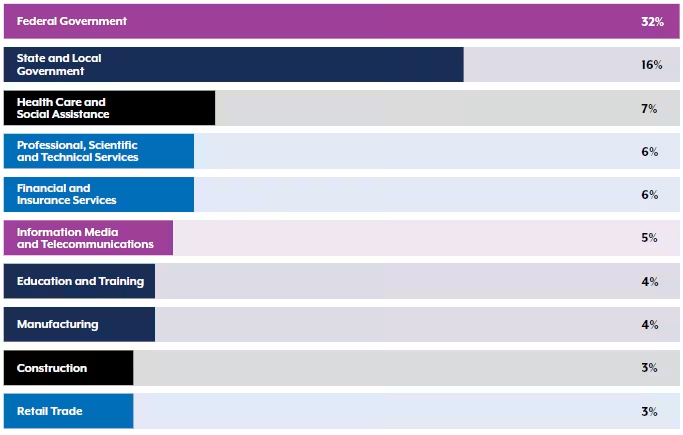
- Federal Government: 32%
- State and Local Government: 16%
- Health Care and Social Assitance: 7%
- Professional, Scientific and Technical Services: 6%
- Financial and Insurance Services: 6%
- Information Media and Telecommunications: 5%
- Education and Training: 4%
- Manufacturing: 4%
- Construction: 3%
- Retail Trade: 3%
Note: ASD’s ACSC categorises sectors following the Australian and New Zealand Standard Industrial Classification (ANZSIC) Divisions from the Australian Bureau of Statistics.
In FY2025–26, Government again reported the highest number of incidents, led by the Federal Government, likely due to Government’s additional reporting obligations. Of note, Health Care and Social Assistance rose to be the most frequently reporting non-government sector, followed by Professional, Scientific and Technical Services. This year saw the emergence of the Manufacturing sector into the top 10, having the largest increase in incident reports across all sectors, while Transport dropped out of the top 10.