
Essentials for enterprise IT
Guidance to help organisations protect their enterprise IT environments from sophisticated cyber threats.
At a glance
This chapter provides organisations and cyber security practitioners guidance on how to apply the ASD Essentials framework to enterprise IT environments. The guidance outlines eight domains, grouped into priority phases to support organisations to progress through implementation.
Key actions
Understand the ASD Essentials framework structure and how it applies to enterprise IT environments.
Familiarise yourself with the Domains and risk context and how these apply to your organisation.
Understand the priority phases to inform implementation planning for your organisation.
Introduction
The Australian Signals Directorate (ASD) provides cyber security advice and services to government, critical infrastructure, industry, small business and individuals. Part of that function is publishing prioritised, practical guidance that helps organisations direct their finite resources to the mitigations that matter most. This guidance is designed to help these organisations protect enterprise IT environments from sophisticated cyber threats.
What is enterprise IT
Enterprise IT refers to the IT environments operated by organisations whose scale, complexity, regulatory exposure or reliance on technology requires a structured and deliberate approach to the management of cyber security.
Enterprise IT environments typically include:
- multiple interconnected systems supporting different business functions
- identity and access arrangements that span a workforce and an extended user population
- dedicated cyber security and IT functions with defined roles
- formal governance over technology investment, risk and compliance.
ASD Essentials framework structure
Every ASD Essentials chapter uses the same three layers:
- Principles describe the security outcomes an organisation aims to achieve.
- Actions describe what must be done to achieve them.
- Domains describe where that work applies.
The three layers answer a sequence of implementation questions, as shown.
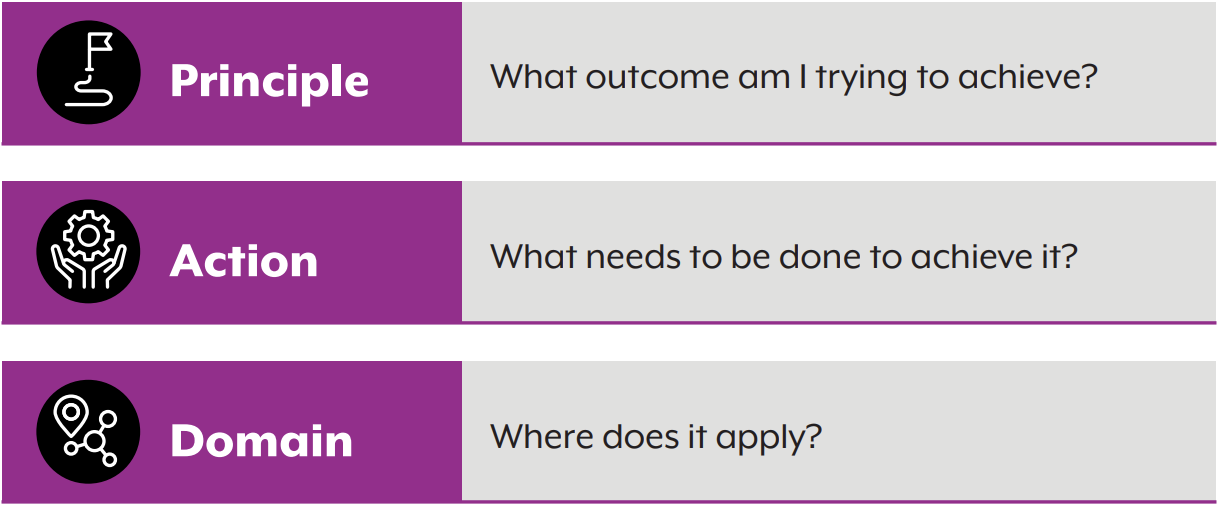
To implement an Essentials series chapter, an organisation works through each action in the domains to which the action applies. The remaining content supports this implementation.
More about the Essentials
The ASD Essentials series includes the following suite of publications and guidance:
Overview publications
- Reading guide
- What is the Essentials series
- The case for change
- The Essentials for senior executives
- Which chapter should I start with?
ASD Essentials series chapters
Supplemental publications
Small and medium sized businesses that do not operate at the scale of enterprise IT can still use this guidance where relevant. For example, the security outcomes described by the principles within the Essential series are equally important for smaller organisations. What differs is how those outcomes are achieved and how much responsibility sits with service providers and vendors.
ASD publishes tailored cyber security guidance for small businesses, home offices and individuals.
Enterprise IT chapter elements
Domains
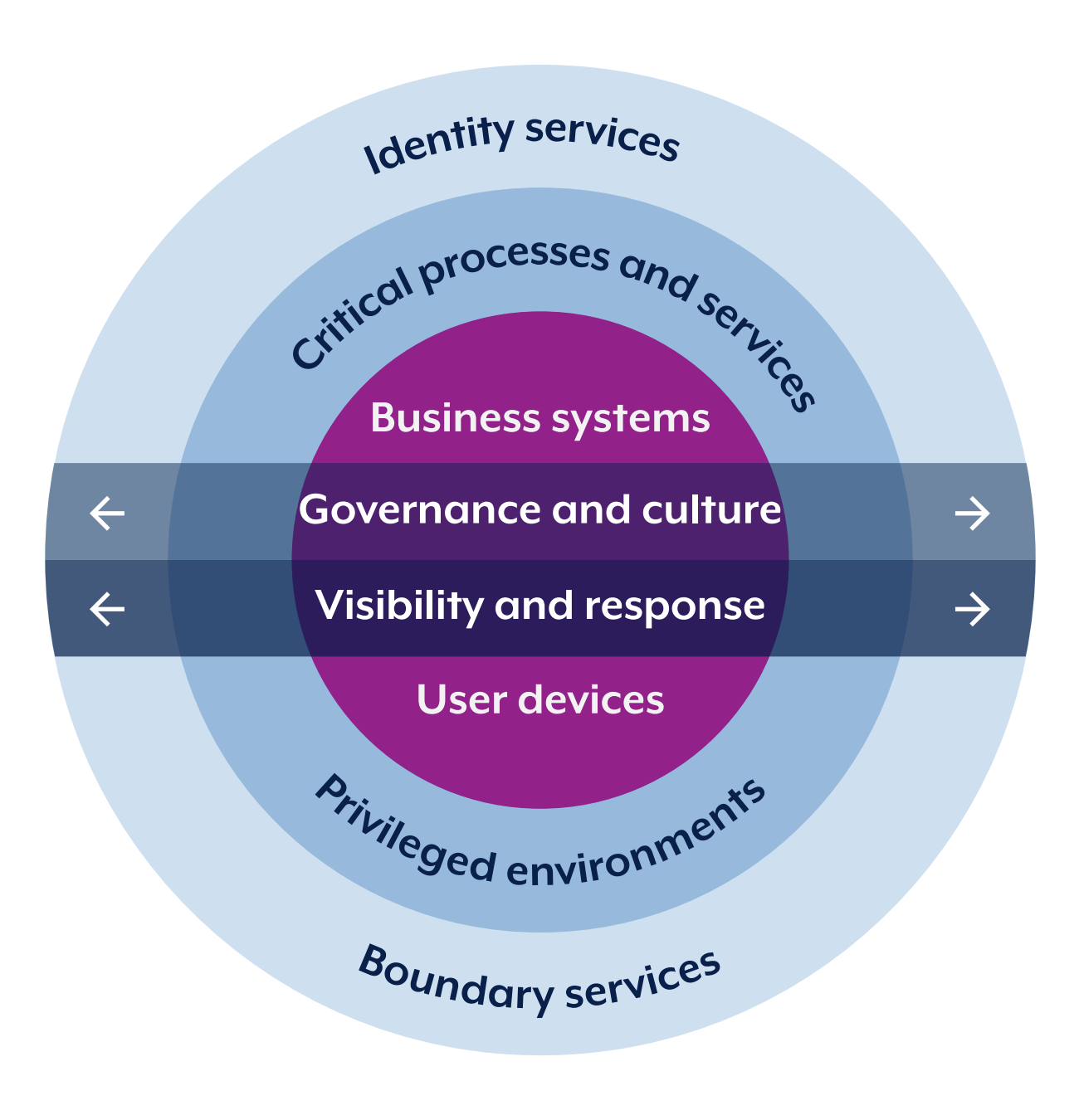
The chapter defines eight domains. Six technical domains group systems, services and assets that share similar cyber security risks.
Non-production environments, including development, testing and staging, are in scope. Assign them to domains on the same basis as any other asset, according to their function, connectivity, data, privileges and potential impact on production.
Some non-production environments can reach production or change what runs in it. Where an environment holds production trust, administrative access, or the ability to modify or deploy to production, organisations should protect it to the same level as the production environment it can affect.
Two capability domains – Governance and culture, and Visibility and response – apply across all technical domains. Table 1 describes each domain and the cyber security risk it addresses.
| Domain | Description | Risk Context | |
|---|---|---|---|
| Governance and culture | Policies, risk management processes, roles and security culture that underpin cyber security program. | Unclear ownership and accountability can lead to inconsistent security decisions and outcomes degrading over time. | |
| Visibility and response | Procedures and capabilities for detecting, analysing and responding to cyber security events and incidents. | Limited visibility and response can delay the detection, analysis and containment of intrusions. | |
| Boundary services | Assets at network boundaries that broker connectivity between environments of different trust levels, including internet-facing services and edge devices. | Internet-facing and boundary systems are routinely exposed to adversary scanning and exploitation making them common targets for initial access. | |
| Identity services | Enterprise-wide identity, credential and access management services such as directories, authentication and authorisation services or credential stores. | Compromise of enterprise-wide identity services can enable an adversary to gain persistent or privileged access across the enterprise. | |
| Critical processes and services | Core processes and services that are critical to delivering primary organisational outcomes. | Compromise or loss of these systems can disrupt the organisation’s ability to deliver critical outcomes or services. | |
| Privileged environments | Systems and services that support privileged activities, management services and high-impact administrative functions. | Compromise of privileged systems can give an adversary extensive control over systems, services and security controls. | |
| Business systems | Supporting enterprise functions that collectively enable organisational operations. | Compromise can disrupt day-to-day operations and provide pathways to more sensitive or critical systems. | |
| User devices | Endpoints issued to the workforce, including desktops and laptops. | Widespread use and exposure make user devices common entry points for adversaries seeking access to the environment. | |
Priority phases
In each chapter, the domains are grouped into priority phases. The phases set out the order in which ASD recommends the domains be addressed. This reflects where ASD assesses that effort delivers the greatest and most rapid reduction in risk.
Priority phases are a sequencing mechanism, not a rating. They do not represent assurance over the effectiveness of controls, compliance against a standard or an organisation’s cyber security maturity against a particular class of adversary. The recommended sequence is designed to support organisations to progress through each phase, scaling and hardening their environments as they go and reducing their overall cyber security risk.
The technical domains are grouped into the following priority phases.
Priority phase 1: Boundary services and Identity services
Boundary services and Identity services are prioritised because they are common pathways for adversaries seeking initial access to an organisation’s environment. Weaknesses in these domains can enable unauthorised access and undermine security controls elsewhere in the environment. Addressing them together strengthens the protection of external access pathways and the identities used to access systems and services.
Priority phase 2: Critical processes and services and Privileged environments
Privileged environments can provide adversaries with elevated access following an intrusion. Critical processes and services are prioritised because their compromise or disruption could have significant consequences for an organisation. Addressing these domains together reduces the likelihood that an adversary can escalate access and affect systems and services that are critical to organisational outcomes.
Priority phase 3: Business systems and User devices
Business systems and User devices are widely distributed across enterprise IT environments and are common targets for adversaries. They are addressed after the earlier phases so organisations can build on the protections established for boundary, identity, privileged and critical environments. This sequencing helps reduce the likelihood that compromise of a business system or user device can spread across the organisation’s environment.
The two capability domains (Governance and culture and Visibility and response) apply across all phases and expand as implementation progresses.
ASD recommends implementing the technical domains in the sequence shown to focus cyber security effort where it provides the greatest benefit against current adversary tradecraft.
Refer to the Implementation planning guide for detailed planning advice.
ASD Essentials for enterprise IT matrix
Matrix structure and use
Each principle states a cyber security objective drawn from ASD’s Information Security Manual (ISM). Principles align with the corresponding ISM principle identifier, such as GOV-01. These identifiers are provided for traceability and do not indicate an implementation order.
Actions describe what organisations must do to achieve each principle in technology-agnostic terms. Organisations implement these actions through controls that are appropriate to their IT environment, risk profile and regulatory obligations. Relevant controls can be found in the ISM and other ASD guidance.
For guidance on applying these principles and actions to artificial intelligence (AI), refer to AI considerations within the ASD Essentials series.
Where applicable, the technical domain matrix maps actions to the MITRE ATT&CK techniques they are intended to address.
The matrices are organised by capability and technical domains:
- Matrix 1 and 2 cover the two capability domains.
- Matrix 3 maps actions across the six technical domains.
Capability domains
Governance and culture
| Principle | Action |
|---|---|
| GOV-01 - Executive cyber security accountability | Formally define and establish executive and board-level accountabilities for cyber security, including setting, monitoring and adjusting organisational risk appetite, and review these accountabilities at a defined cadence. |
| GOV-08 - Executive artificial intelligence accountability | Establish and maintain executive accountability for the use, governance and risk management of artificial intelligence within the organisation. |
| GOV-04 - Cyber security resourcing | Assign sufficient cyber security personnel and resources with the required skills to operate, monitor, maintain and manage the lifecycle of security controls and define cyber security responsibilities within role descriptions. |
| Periodically review cyber security resourcing against cyber threat trends, cyber security incident outcomes and organisational changes. | |
| GOV-03 - Security risk management assurance | Establish and maintain a risk management methodology and plan that is used to assess and treat cyber security risks. |
| GOV-11 - Supplier cyber security assurance | Select and engage suppliers of software, hardware and services on the basis of a cyber supply chain risk assessment proportionate to the risk the supplier introduces, and retain appropriate assurance evidence to support the decision. |
| Maintain current assurance that suppliers continue to meet their cyber security commitments, and act when that assurance lapses or the supplier’s risk changes. | |
| GOV-14 - Legacy system management | Establish and maintain a process for identifying, assessing and treating cyber security risks associated with legacy systems and unsupported technologies through compensating controls, enhanced monitoring and assurance until the systems can be removed or replaced. |
| PRO-14 - Cyber security awareness training | Update and provide cyber security awareness training on a regular basis to reflect current threats and operational considerations. |
Visibility and response
| Principle | Action |
|---|---|
| IDE-01 - Asset identification | Use an approved asset inventory mechanism that supports automated discovery to detect new and changed physical and non-physical assets. |
| IDE-04 - Security risk identification | Identify relevant weaknesses, malicious actor techniques and cyber threat behaviours when undertaking risk assessments and review these inputs on a continuous basis. |
| PRO-13 - Identity, credential and access management | Identify unsecured keys, secrets and credentials by regularly scanning codebases, configuration files, file shares and user collaboration platforms. |
| DET-01 - Centralised event logging | Establish a centralised event log storage capability that protects logs from unauthorised access or modification. |
| DET-02 - Cyber security event detection | Ensure detection logic identifies unauthorised changes, anomalous authentication activity and suspicious software execution. |
| DET-03 - Cyber security incident identification | Triage alerts and events in a timely manner to determine whether cyber security incident thresholds have been met. |
| Use indicators from across identities, applications, data and infrastructure activity rather than isolated signals when identifying cyber security incidents. | |
| DET-05 - Detection capability efficacy | Review detection coverage periodically to identify gaps arising from new assets, services or architectural changes. |
| RES-05 - Cyber security incident coordination | Integrate external coordination obligations into cyber security incident response activities where required. |
| RES-03 - Cyber security incident response | Use documented, tested and approved cyber security incident response procedures when responding to cyber security incidents. |
| RES-04 - Cyber security incident insights | Perform post-cyber security incident reviews to identify the security gaps that enabled each stage of the cyber security incident. |
| Evaluate the monitoring coverage and cyber security incident response procedures following cyber security incidents. |
Technical domains
| Principle | Action | MITRE ATT&CK | Boundary services | Identity services | Critical processes and services | Privileged environments | Business systems | User devices |
|---|---|---|---|---|---|---|---|---|
| IDE-01 - Asset identification | Maintain current records of assets including infrastructure, operating systems, applications, identities, credentials and data. | ✔ | ✔ | ✔ | ✔ | ✔ | ✔ | |
| PRO-01 - Secure system lifecycle | Design systems securely to provide visibility, enforce authorised access, protect data, minimise required and default privileges, limit exposed services and remove unnecessary functionality. | ✔ | ✔ | ✔ | ✔ | ✔ | ✔ | |
| Secure build and deployment processes to enforce controls consistently across systems. | ✔ | ✔ | ✔ | ✔ | ✔ | ✔ | ||
| PRO-16 - Cyber supply chain security | Assess the integrity and authenticity of software, components and updates before use, and verify provenance where suitable supplier evidence is available. | ✔ | ✔ | ✔ | ✔ | ✔ | ✔ | |
| Use vendor advisories and threat intelligence to maintain awareness of supplier, product and component exposure to compromise, and act within timeframes proportionate to the risk. | ✔ | ✔ | ✔ | ✔ | ||||
| PRO-13 - Identity, credential and access management | Identify and disable or remove default and unused accounts regularly, permitting exceptions only where the account is documented, justified, hardened and monitored. | ✔ | ✔ | ✔ | ✔ | ✔ | ✔ | |
| Store authentication keys, secrets and tokens in approved secure repositories with access controls, including MFA. | ✔ | ✔ | ✔ | ✔ | ✔ | |||
| Use phishing-resistant MFA for users authenticating to systems, including from untrusted, external or high-risk locations. | Multi-Factor Authentication Request Generation | ✔ | ✔ | ✔ | ✔ | ✔ | ✔ | |
| Disable legacy authentication protocols or, where this is not feasible, restrict and monitor their use, apply compensating controls and establish a time-bound decommissioning plan. | ✔ | ✔ | ✔ | ✔ | ✔ | ✔ | ||
| Ensure that user, machine, system and service account credentials are unique per system or account, particularly in high-privilege contexts. | ✔ | ✔ | ✔ | ✔ | ✔ | ✔ | ||
| PRO-12 - Least privilege access | Periodically review and update access privileges in alignment with current roles, duties and business requirements. | Account Manipulation | ✔ | ✔ | ✔ | ✔ | ✔ | ✔ |
| Grant only authorised administrative roles permissions to create, modify or delete accounts and roles, and access privileged functions or applications. | ✔ | ✔ | ✔ | ✔ | ||||
| Provision user, administrative and non-person accounts with only the minimum access and privileges required to perform defined operational functions. | ✔ | ✔ | ✔ | ✔ | ||||
| PRO-05 - Secure administration | Ensure administrative activities can only be performed from dedicated and hardened environments that are isolated from unprivileged user workloads. | ✔ | ✔ | ✔ | ✔ | |||
| Enforce explicit session establishment controls before privileged actions are permitted, including the use of time-bound privilege grants. | ✔ | ✔ | ✔ | ✔ | ||||
| Record all administrative or management actions that modify systems, configurations or controls, including the details of the associated user, timestamp and target. | ✔ | ✔ | ✔ | ✔ | ||||
| PRO-04 - Secure configuration management | Define approved configuration baselines, informed by vendor and industry hardening guidance, that disable or remove unnecessary services, insecure settings, and unsupported or weak communication protocols. | ✔ | ✔ | ✔ | ✔ | ✔ | ✔ | |
| Deploy approved configuration baselines on systems, including infrastructure, operating systems and applications. | ✔ | ✔ | ✔ | ✔ | ✔ | ✔ | ||
| Detect and respond to configuration drift using scheduled technical assessments and, where supported, automated monitoring, based on system criticality and change rate. | ✔ | ✔ | ✔ | ✔ | ✔ | ✔ | ||
| PRO-06 - Vulnerability management | Identify known software and configuration weaknesses of assets through continuous and repeatable assessment activities, including vulnerability scanning activities. | Exploit Public-Facing Application Exploitation for Privilege Escalation | ✔ | ✔ | ✔ | ✔ | ✔ | ✔ |
| Apply security patches or updates within defined risk‑based timeframes or automatically where operational impact is low. | Exploit Public-Facing Application Exploitation for Privilege Escalation | ✔ | ✔ | ✔ | ✔ | ✔ | ✔ | |
| Remediate or mitigate vulnerabilities exceeding defined risk thresholds within defined timeframes based on exploitation, exposure, criticality, impact and compensating controls, and verify treatment effectiveness. | Exploit Public-Facing Application Exploitation for Privilege Escalation | ✔ | ✔ | ✔ | ✔ | ✔ | ✔ | |
| PRO-07 - Trustworthy software | Permit only supported, verified and organisation-authorised software to execute on systems, with exceptions minimised, formally risk accepted, time-bound, monitored and regularly reviewed. | Command and Scripting Interpreter | ✔ | ✔ | ✔ | ✔ | ✔ | ✔ |
| Restrict administrative and management tooling to approved software sets and executed from only authorised, known locations. | Command and Scripting Interpreter | ✔ | ✔ | ✔ | ✔ | ✔ | ✔ | |
| PRO-10 - Regular and proven backups | Back up important data, applications and settings on a defined schedule to secure, resilient storage protected by encryption and immutable, offline, logically isolated or equivalent controls. | ✔ | ✔ | ✔ | ✔ | ✔ | ||
| Isolate backup repositories from general user environments and production workloads, ensuring they are separated from primary systems to prevent unauthorised access, modification or deletion. | ✔ | ✔ | ✔ | ✔ | ✔ | |||
| Conduct regular testing of backup and restoration procedures to ensure that backups are reliable and capable of meeting defined recovery time objectives and recovery point objectives. | ✔ | ✔ | ✔ | ✔ | ✔ | |||
| PRO-18 - Network segmentation and segregation | Isolate systems within network zones based on business criticality and trust level, and restrict and monitor inbound and outbound access to explicitly approved pathways and services. | ✔ | ✔ | ✔ | ✔ | ✔ | ||
| Limit lateral movement between, and within, network segments to explicitly approved pathways and services, based on business requirements and trust levels. | ✔ | ✔ | ✔ | ✔ | ✔ | |||
| PRO-09 - Content filtering | Inspect outbound content flows to detect unauthorised transfer of sensitive or high-value data. | ✔ | ✔ | ✔ | ✔ | ✔ | ||
| Block outbound network connections to known malicious or untrusted destinations. | ✔ | ✔ | ||||||
| Inspect inbound content from external or untrusted sources to prevent delivery of malicious or unsafe content. | ✔ | ✔ | ||||||
| PRO-14 - Cyber security awareness training | Ensure all personnel receive cyber security awareness training, that is tailored to how they will interact with systems, applications and data in their assigned roles, before being granted access to organisational systems and data. | ✔ | ✔ | ✔ | ✔ | |||
| DET-01 - Centralised event logging | Protect event logs from unauthorised access, modification or deletion, including by encrypting them during transit and at rest and securing the systems and accounts used to store, manage and analyse them. | ✔ | ✔ | ✔ | ✔ | ✔ | ✔ | |
| Forward high-value, security-relevant event logs and configuration changes from infrastructure, operating systems and applications to a central log storage capability. | ✔ | ✔ | ✔ | ✔ | ✔ | ✔ | ||
| DET-04 - Baselined high-risk access activities | Continuously monitor and analyse software execution behaviour on systems to detect where legitimate tools and utilities are being used for malicious purposes. | ✔ | ✔ | ✔ | ✔ | |||
| DET-02 - Cyber security event detection | Ensure event logs are normalised, time-synchronised and enriched to support correlation across systems and environments. | ✔ | ✔ | ✔ | ✔ | ✔ | ✔ |
